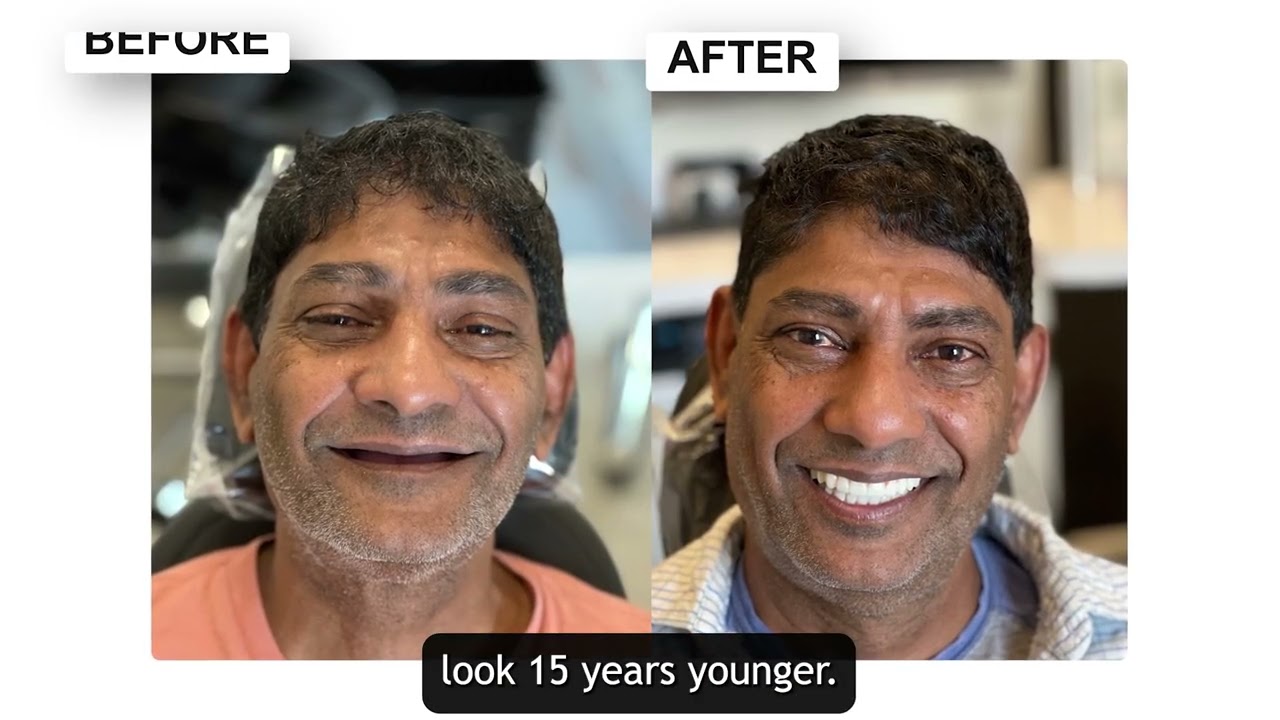
How and why does our patient’s face look completely different after dental implants?
Particularly, the question we always get is: how and why does our patient’s face look completely different? It's a really, really valid and good question because a lot of times, when you see our before-and-after pictures, it literally looks like a different human being from the before to the after.
This was a little puzzling to me at first. Honestly, I got into full-mouth rehabilitation with dental implants about 5 years ago or so. I always knew that my patients’ functionality, meaning their ability to chew and eat and finally have corn on the cob, steak, and chicken, would be there. I knew that they'd have a more beautiful smile because we're fixing all the teeth. But I didn't realize the bigger effect it would have on the entire face and, honestly, on the entire person. As funny as that sounds, it's kind of like a discovery I made here while helping my patients.
The one way that I look at it now is that a patient’s appearance is tied to their teeth, both physically and, as funny as it sounds, mentally. A lot of times, if you're a person who's never struggled with your teeth, the mental part might be like, “I don't know. That doesn't really make any sense. They got some bad teeth and are getting them fixed.” But when you're really struggling with your teeth your whole life, you're in pain, you're unable to smile in photos with family, it really does have a mental toll on my patients.
How does tooth loss physically change the face?
Going toward the physical part: of course, we fix the smile. The patient looks happier and has nice, beautiful teeth. But the strange thing is that it does actually change the face of some of my patients. The reason is that a lot of times our mouth and our teeth are what give our face its actual structure.
A kind of silly example that I can use is that Wicked Witch of the West face that we know. We always see a witch and, for some reason, she's got the drawn-in cheeks and the big pointy chin. Believe it or not, that's from tooth loss. Some of the original witches, maybe in Salem back in the day, who knows, might not have had any teeth. Then what happens is the teeth go away, and as the teeth go away, the bone also goes away. Our body, when it sees that there are no teeth, thinks that we don't need bone in our mouth. So the bone goes away. And the way that it shrinks is interesting. Actually, the top jaw, where the teeth are, will shrink in and up, and the bottom jaw kind of stays out. So over time, it looks like the chin is coming out and the top is going in. But it's just a process that we call resorption.
Another thing that happens, which makes it look kind of like that face, is that we're losing some vertical dimension, meaning the way we close now. If we’ve got no teeth, we can actually close our mouth more and more and more, and you can get that scrunched look to your face. So if your face is losing both vertical dimension, meaning you can now have a scrunchier face, and horizontal support, the whole face collapses. What happens when the face collapses? You definitely look older. You have more wrinkles. Even your eyes can have more dark circles under them, and everything kind of looks collapsed and falls in on itself. This is one thing that we associate with older age because you're getting wrinkles, the skin is a little bit more saggy, etc. So a lot of our patients who have tooth loss, even being in their 20s or 30s, can start to get a much older look to their face.
What happens when we restore teeth with implants?
We're not just restoring their teeth, we're also restoring the structure where the bone used to be. When I show my patients an actual arch of implants, a lot of times it's not just the teeth. It's also the teeth with what almost looks like gum because we have to restore a portion of the face. This is why we call it full-mouth rehabilitation: rehabilitating the entire mouth, not just the tooth structure.
With our patients who have kind of accelerated bone loss or have been missing teeth for a long time, their face can look scrunched in and they look older. As soon as we rehabilitate the size and shape of the teeth and everything goes in properly, now they can't overclose. Now they have teeth that can kind of fill out their face. And a lot of our patients look 15 years younger. A lot of our patients look like they've had maybe a facelift or something like this, or Botox, or some fillers, but we're literally just adding structure to the inside of their mouth and to the face, and it fills everything out.
As you can see from some of our before and afters, these patients are looking much, much younger, more vibrant, happier. So that's kind of the physical portion. That makes sense, right? We're physically rehabilitating.
What is the mental and emotional impact of tooth loss and restoration?
But then there's the mental part, and the mental part is, like I said, difficult for people who have not experienced tooth loss. For people who have experienced tooth loss and all the stigma attached to that, and not wanting to go out with friends and have a drink, and not wanting to eat with your family at dinner because you have to take out your dentures or you think something might break, it really does take a mental toll on my patients.
A lot of times with the pictures, the face looks filled out, but I get a question: why do the eyes look different? Do they have colored contacts? Are you using a special camera? And the answer is no to both of those. I use the same camera. I use the same room. Everything is set up exactly the same. But the eyes do look different, which was also puzzling to me. Like I said, I didn't expect this. This is all through doing hundreds and hundreds and hundreds of these cases and finding the common theme.
What it is, honestly, is our patients’ confidence has completely changed. They're now confident in life. They're happy. I have many times where we have patients who, when we first see them in the office, of course it's a dental office, so they might not be totally happy to be here, but they're usually dragging their feet, going very slowly down the hallway, just looking depressed. Then after they get our first set of teeth and the final set of teeth months down the road, they're different people. I've literally seen some patients almost skipping. They've got a spring in their step. They're happy. They can now hang out with family and get pictures with their kids. It’s the first time they've had Christmas card photos since their children were young. I've had patients who have gotten new jobs. They're going to job interviews they'd never go for. And things have just gotten much better. And you can see it in their eyes. They're relaxed. They're confident. And we see this over and over again. If it was a one-time thing, then I would just mark it off as whatever. Thankfully, this is something we see all the time.
What I love about how I can help my patients is, of course, their functionality. They can chew, they can smile, their confidence is back, they look really, really amazing, they look younger, they look more vibrant. And overall, I encourage you to take a look at our before-and-after photos. They do tell the story. Look at our testimonials on Facebook and Instagram, and our YouTube page is filled with them, and just kind of see for yourself some of these fantastic before-and-afters and transformations that we're able to achieve here at Salvatore Dental. Our passion here, my passion here, is to help patients in the biggest way possible. Of course, we'll fix any kind of issue you have, but if it's really a life-altering, life-changing issue you have because of your teeth, we're here for you.
If you live in or near Saratoga Springs, NY, and are looking for family dental care, contact us at (518) 868-6900 to set an appointment. Our staff would love to talk with you!